Wearable Shielding Fabric: How It Works and What It Cannot Do
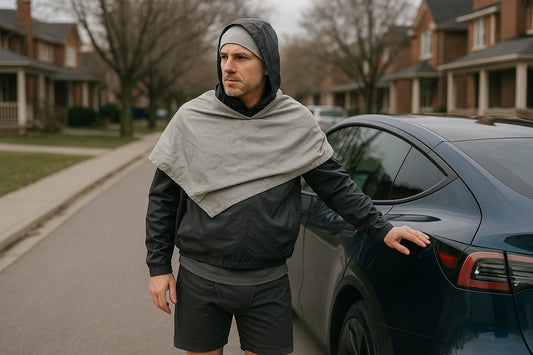
Shielding fabric is not complicated. Silver, copper or nickel fibres are woven through or bonded onto a textile, giving it a continuous conductive surface. When radio-frequency energy meets that surface, most of it is reflected and some is absorbed, so less passes through to whatever is behind the fabric. Cut that fabric into a garment and you have wearable shielding.
What is complicated is knowing whether a given garment actually does it, and by how much. This article is about how to tell.
How shielding effectiveness is measured
Shielding effectiveness is expressed in decibels of attenuation, and it is measured across a frequency sweep rather than at a single point. That matters, because performance varies by orders of magnitude across the spectrum. A fabric that performs strongly at 2.4 GHz may perform quite differently at 700 MHz.
This is why you will not find a headline percentage on our product pages. A figure like "99.9% blocking" tells you nothing without the frequency it was measured at and the method used to measure it. When you see one, ask which frequency. The answer is informative either way.
The test nobody runs: laundering
Here is the difference between good shielding fabric and cheap shielding fabric, and it does not show up on day one.
Conductive coatings degrade. Detergent, agitation, heat, chlorine and fabric softener all attack the conductive layer. A thin coating on a cheap garment can lose a substantial part of its attenuation within twenty washes, while the garment looks exactly the same. A figure measured on new material does not describe a garment after a year of wear.
Ask whether a seller has retested after laundering. Most have not, because the result is inconvenient.
It is also why our care instructions are strict and specific: cold delicate cycle, neutral detergent, no bleach, no fabric softener, no chlorine, air dry, no iron. Those are not generic garment-care boilerplate. Each one is protecting the conductive layer you paid for.
Three things wearable shielding will not do
- It will not shield low-frequency magnetic fields. The 50/60 Hz magnetic fields from building wiring, appliances and transmission lines pass straight through conductive textiles. Blocking them requires ferromagnetic materials, which are heavy, expensive and not something you can wear. If your concern is power-line magnetic fields, shielding fabric is not your answer and we will tell you so.
- It is not a sealed enclosure. A garment has a neck, sleeves, a hem and usually a front opening. RF passes through openings. A garment attenuates energy reaching the area it covers, while in place and intact — that is the honest description of what it does.
- It does nothing about sources on the inside. A phone in your pocket, under a shielding layer, is inside whatever that layer encloses.
What the range covers
Our Body Guards range spans tees, wraps, briefs, headwear and outerwear, all built from conductive silver-fibre textiles with construction intended to keep the shielding layer where it needs to be through repeated wear.
If full isolation of a device is what you actually want, a sealed Stuff Guard does that properly and a garment does not. We would rather point you to the right product than sell you the wrong one.
Ask for the report
Test documentation is available for any product in our range. Email info@thefaraday.co, tell us the product, and we will send the shielding effectiveness data, the frequency range and the method used.
Ask other sellers the same question. What comes back — or does not — will tell you most of what you need to know.
We make no health claims for our products.